 March 23, 2026
Key Takeaways:
- Traffic from foreign countries has increased in the past year or so due to AI bots crawling sources.
- Common countries and cities to see on your traffic report or in GA4 are Lanzhou, Ashburn, Singapore, China, and Indonesia.
- Most of this traffic is scraping information for AI systems, so it is not malicious and trying to hack your website.
Within the last year or so, if you work with the data in Google Analytics 4 (GA4) or you receive traffic reports from the platform, you might have noticed a spike in traffic from foreign countries or cities. Many of these hits come from China, Singapore, or Indonesia. More specifically, you might see cities like Lanzhou or Ashburn, VA.
This increase in traffic is due primarily to an influx of non-human bots crawling the web. The good news is that most of these bots are not the bad kind that hack your website and mess things up for you. In general, they are bots working for the AI systems that are evolving, like ChatGTP, Gemini, Meta, and other models.
Why Are AI Bots Crawling My Website?
AI bots crawl websites in order to train AI and for search indexing purposes. From small sites to multi-page mega sites, information is collected with an algorithm so that it can be indexed and used for AI purposes. According to Cloudflare Radar, a global internet traffic hub, there are several categories that “verified” AI bots can fall into. These include:
- Academic Research
- Accessibility
- Advertising and Marketing
- Aggregator
- AI Assistant
- AI Crawler
- AI Search
- Archiver
- Feed Fetcher
- Monitoring and Analytics
- Page Preview
- Search Engine Crawler
- Search Engine Optimization
- Security
- Social Media Marketing
- Webhooks
Most commonly, bots are on your website to crawl for information that can train AI models, generate search results, fetch information in real time for user inquiries, or complete these tasks simultaneously.
Pros and Cons of AI Bots Crawling Your Website
While the AI bots aren’t malicious, not everyone wants them. There are a few things to consider when it comes to whether or not you should let bots crawl your website.
Pros:
- Increased online visibility: Your website might show up in the search summary for platforms like Google or Bing.
- Increased e-commerce visibility: You might gain new bookings, sales, or discoveries via referrals from AI summaries or AEO (Answer Engine Optimization) results.
- Contributing to AI accuracy: While not everyone agrees with the use of AI, it’s not going away any time soon. Having correct, unbiased content for AI bots to crawl will help make AI models more accurate for those who do use them.
Cons:
- Copyright risk to intellectual or artistic property: For artists, bloggers, technical experts with intellectual property, or other media and publishing industries, unique products are at a higher risk of being copied or pirated. You cannot know when bots are citing your work or not, or if they are being used to generate images that copy artistic styles.
- Data privacy and security concerns: If bots are able to access any sort of demographic information about your website’s audience, it raises concerns for privacy. AI crawling without permission is already a slippery slope since there is only so much that website owners can do to prevent or control it.
- Data inflation: Those who use their traffic to identify trends for their campaigns may get inflated numbers that aren’t reflective of their actual website traffic.
At the end of the day, the type of access you want to allow AI crawler bots to have to your website is dependent on your website’s content and your personal preference.
How Do I Distinguish Between AI Bots and Real Traffic in GA4?
If you are marketing to an audience in the US, especially if you aren’t selling anything online, distinguishing your traffic can be as simple as identifying cities and countries in your GA4 account. However, if you market outside of the US, you might need a few more distinguishing factors.
Traffic Trends
Spikes in traffic can happen organically. But, bot spikes will normally be more regular than organic spikes. You can also match up spikes in your audience with any marketing materials or ad campaigns that you may have recently released. If a spike doesn’t correlate to any of your campaigns, it might be bot traffic, especially coming from one of the hotspot cities.
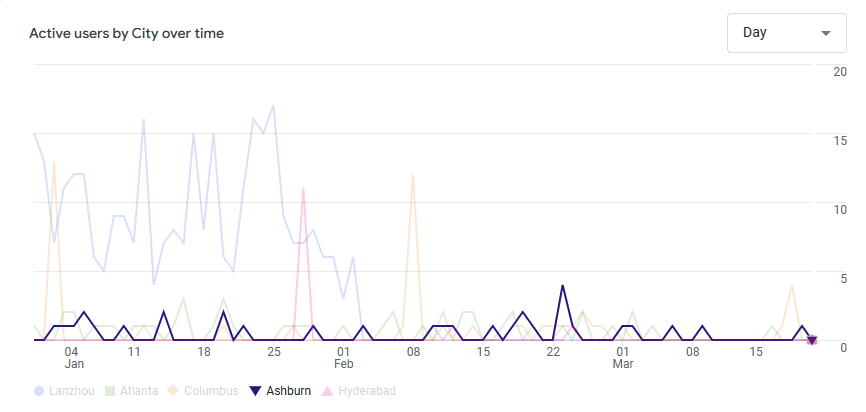
As you can see in the screenshot above, the searches coming from Ashburn, VA are more regular than you would see from human traffic.
Direct Traffic vs Organic Searches
Most search engines collect demographic data about the users that search and participate in activity on their platform. In GA4, this would be Google, and they do collect certain data. While direct traffic—i.e. traffic that arrives directly to your website instead of via searches—could be users who are familiar with your name, brand, or product, if you aren’t a household name or big brand, a large spike in direct traffic could indicate AI bot traffic.
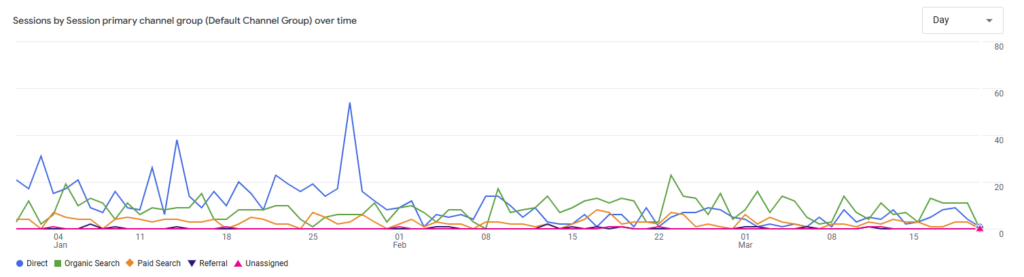
In the graph of a website’s session acquisition below, we see that Direct Traffic has several more severe spikes in traffic as opposed to the other groups. When combined with the data that we see in the engaged sessions and, subsequently, the engagement rate below, this can be an indicator of bot traffic.
Engagement Rate
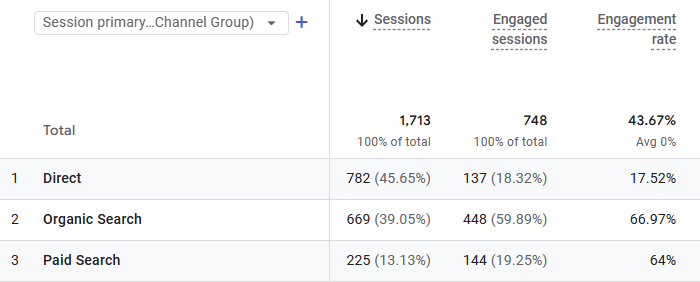
Even further in the user demographic of traffic acquisition, you should be able to see an engagement rate assigned to each traffic source. Significantly lower engagement rates or bounces, especially for direct traffic, can be a characterization of AI bots.
We can see in the session traffic data table for the same website as the graph above that, while direct traffic is this site’s #1 group for total sessions acquired, it has significantly lower numbers for engaged sessions and engagement rate in comparison to the other acquisition groups.
FAQs About AI Bot Crawling
- Is AI scraping my website content?
If you do not have any limitations set on your website that filters or blocks bot traffic, it is likely that your content is being scraped for AI training, search results, and generated content. - Will AI bots affect my website performance or bandwidth?
It has the potential to. Massive amounts of bot traffic could overload your server and make your website slow or unavailable. It depends on how much bot traffic you experience at one time. - Do AI crawlers help or hurt SEO?
They can do both. If your content is optimized to rank high in AEO systems, you could have traffic from recommendations from page summaries or search results in AI chat models. However, scraped information without citations is also affecting clicks everywhere because many people don’t take the extra step and click into information-based websites as a source and rely on AI systems for answers instead.
If you have questions about AI traffic or traffic reports, Honeywick offers premium server hosting services that include site heath monitoring. We also offer reporting services on monthly, quarterly, or yearly bases, and can help you to identify trends in your data. Honeywick has been providing digital services to businesses on a national level since 2012, offering social media marketing, software development, web hosting, graphic design, custom illustrations, SEO optimization, content creation, branding, and more for digital success in the online world. Call us today at 502-873-3866 or Give Us a Shout on our website’s contact form to connect!